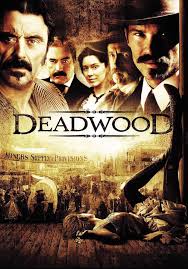
There is no television drama that sounds like Deadwood. David Milch’s language — that extraordinary amalgam of Shakespearean syntax, frontier vernacular, and profanity deployed with the precision of punctuation — is so distinctive that it constitutes a world in itself. The pilot’s first task is to establish that language as a legitimate dramatic register rather than an affectation, and it does so by ensuring that every character speaks it with complete conviction from their very first line. The world of the Deadwood camp is built, before anything else, out of words. For any writer thinking seriously about voice — about how language can do world-building work that no amount of production design can replicate — the pilot is essential study.
The structural decision at the heart of the pilot is one of David Milch’s most audacious: Deadwood is a place without law, and the show’s central question is how law — how any form of collective order — comes into existence from nothing. Seth Bullock arrives in the camp as a man trying to leave violence behind; Al Swearengen runs the camp as a man who has built an empire on it. Their first, circling encounter establishes the show’s entire dramatic geometry: order versus power, conscience versus pragmatism, the man who wants to build something legitimate and the man who has already built something that works. That opposition is as old as drama itself, and Milch’s achievement is to locate it in a specific historical moment — the 1876 gold rush camp on unceded Sioux territory — where its stakes are at their most naked. Writers looking for story structure help would do well to study how the pilot uses historical specificity not as backdrop but as pressure: the absence of law is not a setting, it is the dramatic engine.
The pilot is also a masterclass in the introduction of a large ensemble under pressure of time. Within its first hour, Deadwood establishes Bullock, Swearengen, Sol Star, Wild Bill Hickok, Calamity Jane, E.B. Farnum, and a dozen further characters — each one distinct, each one immediately legible, none of them introduced through anything as crude as exposition. We understand who these people are by watching them act under pressure, which is the only method that produces genuine dramatic characterisation rather than the appearance of it. Close script analysis of the pilot’s first thirty minutes — the economy with which each character is placed, the speed with which their wants are made clear — is one of the most instructive exercises available to a writer developing an ensemble drama.
If your screenplay is wrestling with questions of voice, world-building, or ensemble construction — if you’re trying to build a complete world on the page and want experienced, detailed screenplay feedback from a script consultant who takes that ambition seriously — I’d love to read your work. Get in touch to find out more about the script consultancy services I offer.
To find out more read the pilot script here