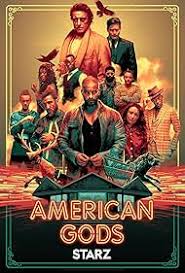
The American Gods pilot opens not with its protagonist but with a Viking longship running aground on an unknown shore, its crew making a blood sacrifice to a god who may or may not be listening. It is a cold open of extraordinary strangeness — operatic, violent, completely committed to its own register — and it serves a precise dramatic function: it tells the audience, before a single word of the contemporary story has been spoken, that this is a world in which the gods are real, their hunger is real, and the price of their attention is real. Everything that follows — Shadow Moon’s mundane prison release, his strange new employer, the gathering weirdness of the American road — is coloured by that opening. The pilot establishes its mythological reality not through exposition but through immersive assertion. Believe this, it says. And then it gives you no choice.
Bryan Fuller and Michael Green’s adaptation of Neil Gaiman’s novel faces the same fundamental challenge as all literary adaptation: how do you translate a work whose power is inseparable from its prose voice into a visual medium that cannot reproduce that voice directly? Their solution is to find television’s equivalent of Gaiman’s narrator — that quality of bemused, intimate, slightly dangerous storytelling — in the show’s aesthetic register itself. The direction, the colour palette, the sound design, the pacing: all of it speaks in the same register as the novel’s voice, so that the show feels authored even when it cannot be literary. For writers seeking screenplay help with adaptation, this is one of the most instructive examples of the decade: faithfulness to source material is not a matter of preserving plot or dialogue, but of finding the tonal and formal equivalent of what made the original irreplaceable.
The pilot’s story structure is deliberately, provocatively loose by conventional television standards. It moves by image and atmosphere as much as by incident, and it trusts the audience’s willingness to inhabit strangeness without the reassurance of conventional plot mechanics. Shadow’s passivity — his quality of a man to whom things happen, who watches and absorbs without yet understanding — is itself a structural choice: it positions the audience alongside him, equally unanchored, equally at the mercy of a world whose rules are not yet legible. That is a bold decision for a pilot, which is conventionally expected to establish clear stakes and propulsive momentum. Fuller and Green make the atmosphere the momentum, which requires absolute tonal confidence at every level of the production. Writers looking for story structure help with mythological, fantastical, or any tonally ambitious drama will find the pilot’s handling of that confidence worth close attention — and close script analysis will reveal just how precisely every scene is weighted to sustain it.
If you’re developing an adaptation, a mythological drama, or any project where the world’s internal logic needs to be established through atmosphere rather than explanation, I offer screenplay development support, detailed script analysis, and story structure consultancy for writers working at the more ambitious end of the form. I’d love to hear what you’re making.
To find out more read the pilot script here