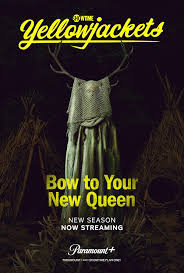
The Yellowjackets pilot opens with a ritual killing in a snow-covered forest — hooded figures, a girl running, a pit, a fire — and then cuts to 1996, to a high school soccer team boarding a plane to nationals. It is one of the most confident structural gambits in recent television: by showing us the destination before the journey, the pilot transforms everything that follows into dramatic irony. We don’t know which of these girls will survive, or what they will become in the surviving, but we know that something happened in those woods that none of them will ever fully leave. That knowledge — partial, terrible, irresistible — is the engine the whole series runs on, and Ashley Lyle, Bart Nickerson and Jonathan Lisco build it into the pilot’s architecture from its very first frame.
The dual timeline structure is handled with exceptional precision. The 1996 storyline and the adult present-day storyline are not merely parallel — they are in constant, active dialogue. Every revelation in one timeline recontextualises what we know about the other; every scene in the past is charged with the knowledge that something will go catastrophically wrong; every scene in the present is haunted by what we can only partially see. For writers seeking story structure help with non-linear or dual timeline narratives, the pilot is a near-perfect demonstration of how to use temporal structure as an emotional instrument rather than a narrative convenience. The question is never simply what happened — it is what it cost, and whether the cost is still being paid. Locating your story’s structural question at that level of depth is, in my experience as a script consultant, one of the things that separates a compelling premise from a truly haunting one.
The pilot’s ensemble work is also worth studying. Lyle, Nickerson and Lisco face the considerable challenge of introducing the same characters at two different life stages — the teenage versions and their adult counterparts — and making both sets simultaneously vivid and individually distinct. The solution is characterisation through contradiction: each adult is defined partly by how far she has travelled from who she was at seventeen, and partly by how much of that girl remains lodged in her, unchanged and unchangeable. That gap — between who we were and who we have made ourselves — is the show’s deepest subject, and the pilot encodes it into its character design from the first episode. Writers looking for screenplay help with ensemble casts spanning multiple timelines will find the pilot’s method here both practically instructive and quietly devastating.
If you’re developing a mystery drama, a non-linear screenplay, or any project where the architecture of what is withheld and what is revealed is the primary dramatic instrument, I offer detailed script analysis, screenplay feedback, and story structure consultancy tailored to exactly those challenges. I’d love to read what you’re working on.
To find out more read the pilot script here