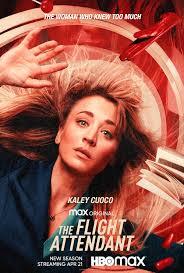
The Flight Attendant opens at full speed, pulling the audience into a story that feels chaotic, disorienting, and immediately high-stakes. From the outset, the pilot aligns us with Cassie’s perspective—unreliable, impulsive, and fragmented—shaping not just what we see, but how we experience it.
At the centre is Cassie, a protagonist defined by contradiction. She’s charismatic and reckless, outwardly in control yet clearly avoiding something deeper. Her dynamic with Alex Sokolov is established quickly but effectively, giving emotional context to the shock of what follows. For writers looking for script help, it’s a strong example of how quickly a character can be drawn through behaviour and decision-making rather than exposition.
Structurally, the pilot leans into momentum and fragmentation. The narrative moves between timelines, memories, and imagined conversations, reflecting Cassie’s unstable state of mind. This approach keeps the audience off-balance in a way that mirrors the character’s experience. If you’re exploring help with your screenplay, it highlights how structure can be used expressively, not just functionally.
The tone blends thriller with dark humour, creating a constant sense of tension that never fully resolves. Scenes often shift unexpectedly, moving from lightness to danger in a matter of moments. For those seeking scriptwriting help, it demonstrates how tonal contrast—when controlled—can heighten both suspense and character.
What the pilot ultimately delivers is a strong sense of subjective storytelling. Everything is filtered through Cassie’s perception, making the audience question what is real and what is constructed. For writers wanting to refine this kind of perspective-driven work, engaging with a script consultant or exploring more focused script analysis help can help ensure clarity without losing complexity.
To find out more download the pilot script here