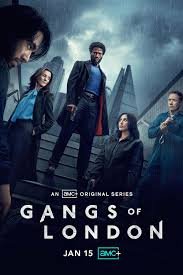
The Gangs of London pilot announces itself with one of the most visceral opening sequences in recent British television — a man burned alive at the top of a tower block, the whole of the city spread out below him. It is an image of deliberate, almost operatic brutality, and it does precisely what a great pilot’s opening image should do: it states the show’s terms without negotiation. This is a world in which power is absolute and its removal is total. Everything that follows is a consequence of that opening fact.
What distinguishes the pilot from the considerable body of British crime drama that precedes it is the relationship between its action and its character work. Gareth Evans — directing from a screenplay he co-wrote with Matt Flannery — is best known for the Raid films, and that background is legible in the pilot’s action sequences, which are choreographed with a spatial precision and physical commitment rarely seen on television. But the more important craft decision is the one that frames those sequences: the violence is never decorative. Every set piece is a scene, with stakes, character decisions, and consequences that advance the story. For writers seeking help with action-driven screenplays, that discipline — ensuring spectacle also does narrative work — is the central lesson the pilot teaches, and it is harder to execute than it sounds.
The story structure is classical in its underlying design: a king is killed, a succession crisis ensues, and every power within the kingdom moves to exploit the vacuum. The pilot maps that geometry with considerable efficiency across a large ensemble, establishing the Wallace family’s internal fractures, the competing loyalties of Sean Wallace, and the grid of international criminal interests that converges on London the moment Finn Wallace dies. What keeps that complexity navigable is the clarity of each character’s want — every significant player in the pilot has a legible objective, and those objectives are immediately, visibly in conflict. That’s the architecture of good dramatic writing regardless of genre, and it’s worth studying in a show that could easily have let world-building crowd out character.
If you’re developing a crime drama, an action-driven screenplay, or any large-ensemble piece where world and character need to be built simultaneously, a script consultant can help you evaluate whether the architecture is holding. We offer script notes, story structure feedback, and full screenplay consultancy for writers working in any genre.
To find out more download the pilot script here