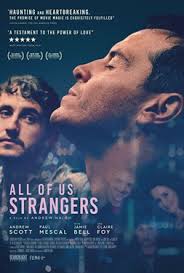
Andrew Haigh’s All of Us Strangers is built around an impossibility rendered with complete emotional conviction: a man in his forties visits the suburban house where he grew up and finds his parents there, exactly as they were when they died in a car accident thirty years ago, willing to have every conversation that death made impossible. The screenplay — adapted by Haigh from Taichi Yamada’s novel — treats this impossibility not as fantasy requiring explanation but as emotional fact requiring exploration. We are never asked to believe in the premise logically. We are asked only to believe in the feeling, and the feeling is so precisely rendered that the question of mechanism never arises. For writers seeking screenplay help with any project where the emotional logic needs to carry more weight than the literal, this is among the most instructive examples the form has produced in years.
The screenplay’s structural achievement is the interweaving of its two central relationships — Adam’s visits to his parents, and his developing relationship with his neighbour Harry — in a way that makes each one illuminate the other without either ever becoming merely functional. The parents represent everything Adam was not able to say, everything he was not able to be seen as, everything that grief foreclosed before it could become understanding. Harry represents the possibility of being known in the present — a possibility that Adam’s unresolved past makes simultaneously urgent and terrifying. Haigh moves between these two worlds with the sureness of a writer who understands that they are not separate stories but the same story told at different distances from the wound. That integration — two narrative strands that are thematically identical even when superficially different — is a model of economical dramatic writing, and it is the kind of structural decision that a script consultant can help you locate and build into your own work from the earliest stages of development.
The dialogue deserves particular attention. Haigh writes the parent scenes with a precision that is almost unbearable in its specificity — these are not conversations about grief in general but about the particular, private, unfinished business of one specific family. The father’s tentative attempts to understand his son’s life; the mother’s mixture of love and the cultural limitation of her moment; Adam’s navigation of what to ask and what to protect — all of it is written with the kind of concrete, irreplaceable detail that is the difference between emotional writing that earns its feeling and emotional writing that merely gestures towards it. For any writer looking for help with their script who is working on intimate or emotionally demanding drama, that discipline — grounding every emotional scene in specific, observed, unrepeatable human detail — is the craft lesson the screenplay most clearly teaches. It is also the hardest lesson to teach in the abstract, and one of the things I look most carefully at when offering detailed screenplay feedback and script analysis.
If you are developing a screenplay where the emotional architecture is the structure — where what your characters cannot say to each other is as load-bearing as what they can — I offer screenplay development support, script consultancy, and detailed script notes for writers working in that territory. This is the kind of writing I find most interesting to work on, and most worth getting exactly right. I’d love to read yours.
To find out more read the screenplay here
What do you think the screenplay of All of Us Strangers gets right — or wrong? Drop your thoughts in the comments below. And if you’re working on a TV script and want sharp, honest feedback on what’s on the page (and what isn’t yet), take a look at my script consulting services here.