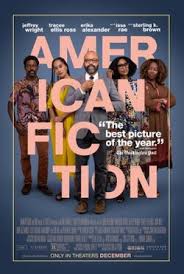
The central irony of American Fiction — that a furious satire about the publishing industry’s appetite for Black trauma ends up being a genuinely moving family drama — is not a contradiction the screenplay resolves, but a tension it sustains with real craft. Cord Jefferson’s adaptation of Percival Everett’s novel is, structurally, two films occupying the same space: a sharp, knowing comedy about cultural expectation and artistic compromise, and a quieter, warmer story about a man whose emotional defences are dismantled by his own family while he is busy being angry about other things. That both films are fully realised within the same screenplay, and that neither cancels the other out, is the most instructive thing about it for any writer working at the intersection of comedy and genuine feeling.
The screenplay’s structural ingenuity lies in how Jefferson uses Monk Ellison’s satirical project — writing a deliberately offensive, stereotypical novel under a pseudonym to expose industry cynicism — as a mirror for his personal story. Every beat of the fake novel’s absurd success is a beat in Monk’s own reckoning with what he has suppressed and what he has refused to examine in himself. The satire and the family drama are not running in parallel; they are the same argument rendered at different temperatures. Monk’s contempt for the industry’s desire for a particular kind of Black authenticity is inseparable from his own complicated relationship with authenticity — in his writing, in his family, in the relationships he holds at arm’s length. For writers seeking help with their screenplay who are working in satirical comedy, that integration is the lesson: the external satirical target should rhyme with the protagonist’s internal blind spot, so that the comedy and the character work are doing the same thing simultaneously.
The family material is handled with a tenderness that the screenplay earns rather than assumes. Jefferson resists the temptation to use the Ellison family as purely functional — as context for Monk’s arc, or as moral corrective to his cynicism. Each family member is given enough space to be a complete, distinct person with their own story, and the film’s emotional weight is distributed across the ensemble rather than concentrated in Monk alone. That generosity of characterisation, in a film whose satirical surface could easily have crowded it out, is a mark of real maturity in the writing — and it is exactly the kind of balance that benefits enormously from a script editor or screenplay consultant asking, at draft stage, whether every character in the room is as fully alive as the protagonist. Close script analysis of the family scenes in particular reveals a screenplay that is doing double and triple duty in every exchange: advancing Monk’s arc, developing supporting characters, and keeping the tonal balance between comedy and feeling precisely calibrated throughout.
If you are developing a screenplay that needs to hold satirical intelligence and genuine emotional weight in the same space — where the comedy and the feeling need to be fused rather than alternated — I offer script consultancy, screenplay development support, and detailed script analysis tailored to exactly that challenge. I’d love to read what you’re working on.
To find out more read the screenplay here
What do you think the screenplay of American Fiction gets right — or wrong? Drop your thoughts in the comments below. And if you’re working on a TV script and want sharp, honest feedback on what’s on the page (and what isn’t yet), take a look at my script consulting services here.