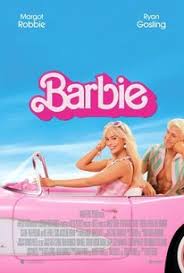
The Barbie screenplay, written by Greta Gerwig and Noah Baumbach, begins with a parody of the 2001: A Space Odyssey monolith sequence in which girls smash their baby dolls against rocks upon first seeing Barbie. It is a cold open of staggering confidence — knowing, funny, theoretically dense, and completely committed to its own intelligence — and it announces, before a single scene of Barbieland has been established, that this is a film that intends to think seriously about the thing it is ostensibly celebrating. For writers working in IP adaptation, that opening is a master class in how to signal your intentions: not through a disclaimer or a tonal caveat, but through a formal act that demonstrates exactly the kind of mind that has been brought to bear on the material.
The screenplay’s structural achievement is considerable and worth unpacking carefully. Gerwig and Baumbach construct a three-act architecture in which each act operates in a different register — the heightened, stylised perfection of Barbieland; the fish-out-of-water comedy of the real world; and the philosophical reckoning of the third act, in which the film’s argument about what it means to be a woman, to be an object of projection, to choose mortality over perfection, is made with a directness that lesser films would have softened into metaphor. That directness is the screenplay’s bravest decision. The speech Barbie is given near the film’s end — about the impossible contradictions of contemporary womanhood — lands not as a lecture but as a dramatic release, because Gerwig and Baumbach have spent the preceding ninety minutes building the structural and emotional conditions in which it can be received. For writers seeking story structure help with any high-concept comedy that needs to carry genuine thematic weight, that architecture — tonal escalation as emotional preparation — is worth studying in precise detail.
The Ken subplot is also a piece of structural writing that rewards close script analysis. Ken’s discovery of patriarchy in the real world, and his subsequent colonisation of Barbieland, functions simultaneously as comic set-piece, satirical argument, and a genuinely generous piece of character writing: Ken’s problem is not simply that he is ridiculous, but that he is a person whose entire identity has been defined by his relationship to someone else, and who therefore has no idea what to do with the first system he encounters that places him at the centre. That is a substantially more interesting dramatic problem than the screenplay needed to give him, and it is the mark of writers who are not content to leave any character merely functional. For any writer looking for help with their script who is developing a comic ensemble — where every character needs to be doing thematic work as well as plot work — the Ken arc is an object lesson in how to make a supporting character structurally indispensable without giving them the lead.
The screenplay also demonstrates something that is genuinely rare in studio filmmaking at this scale: a willingness to let its argument be unresolved. The film does not tell us that the contradictions of womanhood have been solved, or that Barbie’s choice resolves anything beyond her own particular situation. It earns its emotional ending precisely by refusing the false comfort of ideological tidiness. That refusal — holding the complexity rather than flattening it — is a craft decision as much as a political one, and it is exactly the kind of decision that separates screenwriting that is doing serious work from screenwriting that is merely performing seriousness.
If you’re developing an IP adaptation, a high-concept comedy, or any screenplay where the ambition of the ideas needs to be matched by an equally rigorous dramatic architecture, I offer screenplay development support, detailed script notes, and script consultancy tailored to exactly those demands. I’d love to read what you’re making.
To find out more read the screenplay here
What do you think the screenplay of Barbie gets right — or wrong? Drop your thoughts in the comments below. And if you’re working on a TV script and want sharp, honest feedback on what’s on the page (and what isn’t yet), take a look at my script consulting services here.