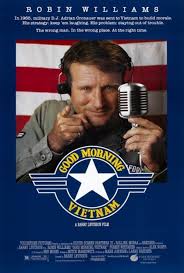
Mitch Markowitz’s screenplay for Good Morning Vietnam is organised around a structural gamble that most screenwriting orthodoxy would counsel against: it opens in pure, exhilarating comedy — the radio sequences in which Adrian Cronauer dismantles the Armed Forces Radio’s starchy self-regard are among the funniest sustained passages in 1980s American cinema — and then, with deliberate and controlled patience, withdraws that comedy until the audience is left sitting in something close to grief. That movement — from laughter to loss, conducted without manipulation or sentimentality — is the screenplay’s defining structural achievement, and it is more precisely engineered than its apparently loose, improvisatory surface suggests. For writers thinking about how tonal shift can function as dramatic argument rather than merely tonal inconsistency, this is one of the most instructive examples the form has produced.
The screenplay’s central structural decision is to make Cronauer’s comedy the first casualty of his growing understanding of the war. As long as the conflict remains abstract — a backdrop, a setting, a context for his irreverence — the comedy can sustain itself. The moment Vietnam becomes specific and human for him — the moment his friendship with Tuan makes the war’s cost personal rather than political — the comedy begins, incrementally and then definitively, to fail him. That failure is not dramatised as breakdown but as a gradual loss of register: the jokes become harder to make, the laughter harder to generate, until the final radio sequence in which Cronauer attempts and cannot sustain his usual performance. For writers seeking help with their screenplay who are working in dark comedy or any tonal hybrid where the comic register is under genuine pressure from the dramatic material, that trajectory — comedy as the first thing the war takes — is a model of how to make tonal shift do thematic work rather than simply reflecting a change in mood.
The screenplay also manages a difficult balance in its portrait of the Vietnamese characters, particularly Tuan and Trinh. Markowitz understands that a film set in Vietnam during the American war carries specific ethical obligations, and the script meets them — imperfectly by contemporary standards, but with considerably more seriousness than most of its contemporaries — by ensuring that the Vietnamese characters have their own agency, their own perspective on the American presence, and their own ironic relationship to Cronauer’s comedy. Tuan’s friendship with Cronauer is genuine, but it is also bounded by a knowledge Cronauer does not yet have, and the screenplay builds that gap into the relationship from the beginning. Close script analysis of their scenes together reveals a screenplay consistently doing more than the surface warmth suggests: the comedy of their exchanges is always shadowed by what Tuan knows and Cronauer doesn’t, which gives the eventual revelation its particular force. This is the kind of subtle load-bearing work that screenplay development support and detailed script notes can help a writer identify in their own drafts — the scenes that appear merely warm but are actually structurally essential.
The radio broadcasts deserve particular attention as a piece of screenwriting craft. They are, formally, monologues — departures from the dramatic situation of the film into a different register entirely. What Markowitz and Williams between them achieve in those sequences is a demonstration that comedy at its most alive is not decoration but revelation: the voice Cronauer uses on air is not a performance distinct from his real self but his real self at its most concentrated and most free. The broadcasts are therefore not interruptions to the drama but its clearest expression, which means the screenplay has to be constructed so that what happens in the studio illuminates what is happening outside it. That integration — ensuring that every formal departure from the main narrative earns its place by deepening the central dramatic argument — is one of the most useful things a screenwriting consultant can help a writer achieve.
If you are developing a screenplay that moves between comedy and genuine darkness — or any project where a performer’s relationship to their own comic gift is part of the dramatic subject — I offer screenplay development support, detailed script notes, and script consultancy tailored to exactly those structural and tonal challenges. I’d love to read your work.
To find out more read the screenplay here
What do you think the screenplay of Good Morning Vietnam gets right — or wrong? Drop your thoughts in the comments below. And if you’re working on a TV script and want sharp, honest feedback on what’s on the page (and what isn’t yet), take a look at my script consulting services here.