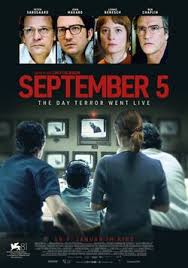
Moritz Binder, Tim Fehlbaum and Alex David’s screenplay for September 5 confines itself, almost entirely, to the ABC Sports control room in Munich on the day of the 1972 Olympic hostage crisis — and in doing so produces one of the most instructive recent demonstrations of what dramatic constraint can achieve. The film never goes to the apartment where the Israeli athletes are held. It never follows the negotiations, the police operation, or the terrorists’ decision-making. It stays, with absolute discipline, in the room where a television network is simultaneously covering a news event and deciding, in real time, what covering a news event of this kind means — ethically, professionally, and in terms of consequences that the people in that room cannot yet foresee. That constraint is not a limitation but the film’s entire dramatic argument, and it is established in the screenplay from the first scene.
The structural decision to remain in the control room is a perspective decision with profound moral consequences. The broadcasters are not simply witnesses to the crisis at the apartment — they are, the screenplay increasingly insists, participants in it of a specific and uncomfortable kind. The control room is not a safe distance from the events outside; it is a different form of involvement in them, one organised around the transformation of human suffering into transmissible content. The ethical weight of that transformation — the question of what a news organisation owes to the people inside the story it is covering, and what it owes to the audience watching — accumulates across the screenplay with the patience and precision of a writer who understands that moral pressure builds most powerfully through accumulation rather than confrontation. For writers seeking screenplay help with any drama set within a professional world where ethical decisions must be made under extreme time pressure, that structural argument — confinement as moral exposure — is worth studying with considerable care.
The screenplay’s management of tension is exceptional and deserves close script analysis. The audience arrives knowing that the outcome is catastrophic — that the athletes will die, that the rescue operation will fail. The screenplay cannot generate suspense about what will happen. What it generates instead — with considerable craft — is suspense about what the people in the control room will do with what is happening: whether they will broadcast the tactical police positions that may cost lives; whether they will prioritise the story over the human beings inside it; whether the decisions made under pressure in that room will be ones anyone will be able to defend afterwards. That conversion of historical outcome into ethical suspense — the audience waiting not for the event but for the moral failure — is one of the most sophisticated narrative techniques the screenplay deploys, and one of the most directly applicable to writers developing any drama built around a crisis that history has already resolved.
The film is also a meditation on the birth of a media landscape that now surrounds us entirely — the moment at which live television coverage of catastrophe became both possible and, apparently, inevitable. The screenplay handles that historical resonance without underlining it, trusting the audience to understand that what they are watching is not only a historical drama but a story about how the world they live in came to look the way it does. That restraint — the refusal to editorialise about implications the drama has already made visible — is a mark of writing with real confidence in its own material, and one of the things I value most highly when offering script analysis and screenplay development support to writers working on historically grounded drama.
If you are developing a confined drama, a historical thriller, or any screenplay where an enclosed professional world is put under extreme ethical pressure, I offer screenplay development support, detailed script notes, and story structure consultancy tailored to exactly those structural and dramatic challenges. I’d love to read what you’re making
To find out more read the screenplay here
What do you think the screenplay of September 5 gets right — or wrong? Drop your thoughts in the comments below. And if you’re working on a TV script and want sharp, honest feedback on what’s on the page (and what isn’t yet), take a look at my script consulting services here.