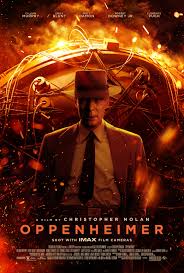
Christopher Nolan’s screenplay for Oppenheimer announces its structural ambition in its first scene: we are in a hearing room, not a laboratory. The bomb has already been built. The war has already been won. What remains — what the screenplay has decided is the true subject of this story — is the question of what the man who built it is worth, and what the country he built it for intends to do with him now that it no longer needs him in the way it once did. That decision — to frame a story about the creation of the atomic bomb as, at its deepest level, a story about institutional betrayal and the destruction of a man by the machinery of the state he served — is the screenplay’s founding structural choice, and it determines every formal decision that follows. For writers thinking about how the framing of a historical story shapes its entire moral architecture, there is no more instructive recent example.
The screenplay’s non-linear structure — intercutting between the 1954 security hearing, the 1959 Senate confirmation proceedings, and the chronological account of Oppenheimer’s life from the 1920s through Trinity — is not a stylistic choice but a structural argument. Nolan understood that a linear telling of Oppenheimer’s story would organise itself around the bomb as climax, which would place the audience in the position of anticipating a detonation rather than understanding a life. By placing the hearings first — by establishing from the outset that Oppenheimer will be destroyed, that the achievement of Trinity will not protect him — the screenplay converts the bomb from destination to irony. We watch the Manhattan Project not as a race toward triumph but as the construction of the instrument of the protagonist’s eventual undoing. Every scene of scientific achievement is shadowed by the hearing room it is moving toward. For writers seeking story structure help with biographical or historical material, that conversion of chronological sequence into structural irony is one of the most sophisticated techniques the screenplay employs, and one of the hardest to execute without losing the audience’s temporal bearings entirely.
The screenplay’s handling of the two parallel legal proceedings is also worth close script analysis. The security hearing — presented in colour, from Oppenheimer’s subjective perspective — and the Strauss confirmation hearings — presented in black and white, from an objective distance — are not simply two timelines but two different epistemic registers. One is interior and partial; the other is exterior and retrospective. That formal distinction does moral work: the colour sequences ask us to inhabit Oppenheimer’s consciousness, to experience the hearing as he experiences it; the black-and-white sequences give us the view from outside, the institutional machinery operating on a human being who is no longer present to defend himself. The screenplay is, in this sense, a formal argument about perspective and power, made visible through a decision about colour. That kind of integration — where a formal choice is simultaneously a narrative choice and a thematic argument — is the hallmark of dramatic writing at its most ambitious, and one of the things I look for most carefully when offering screenplay feedback and script analysis to writers developing complex, formally ambitious material.
The Strauss subplot — the revelation that the security hearing was orchestrated by a man motivated by personal grievance rather than national security — deserves particular attention as a piece of structural writing. Nolan holds that revelation until the film’s final act, which means the black-and-white proceedings have been accumulating a secondary dramatic irony across the film’s entire running time: the institutional machinery grinding Oppenheimer down is revealed, at the last, to be not even impersonal in its injustice but petty. That structural delayed revelation — the bomb beneath the bomb, detonating in the screenplay’s final minutes — is the formal equivalent of the Trinity sequence itself: a long, patient build toward a moment of irreversible consequence. Managing that kind of large-scale structural irony across three hours of non-linear narrative requires a level of architectural planning that is among the most demanding things a screenplay can attempt. It is also, when it works, among the most satisfying.
If you are developing a biographical screenplay, a historical drama, or any formally ambitious project where structure and theme need to be in active, precise dialogue, I offer script consultancy, screenplay development support, and detailed story structure analysis for writers working at that level of ambition. I’d love to read your work.
To find out more read the screenplay here
What do you think the screenplay of Oppenheimer gets right — or wrong? Drop your thoughts in the comments below. And if you’re working on a TV script and want sharp, honest feedback on what’s on the page (and what isn’t yet), take a look at my script consulting services here.