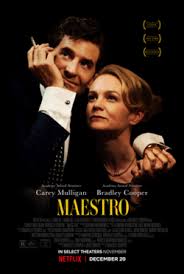
Bradley Cooper and Josh Singer’s screenplay for Maestro makes a decision in its earliest pages that determines everything about the film that follows: it declines to be a film about Leonard Bernstein’s music, and chooses instead to be a film about his marriage. That distinction is finer than it sounds. Bernstein’s music is present throughout — the film’s extraordinary Ely Cathedral sequence alone justifies the entire project — but it is never the subject. The subject is Felicia Montealegre, and what it meant to love a man of Bernstein’s particular genius, particular needs, and particular incapacity for the ordinary satisfactions of a life shared with another person. That is a bolder choice than a more conventional biopic would have made, and it is the source of the screenplay’s most interesting strengths and, in the view of some critics, its most debated limitations.
The screenplay’s structural decision to centre Felicia rather than Leonard is a perspective choice with profound consequences, and one worth examining closely for any writer seeking screenplay help with biographical drama. A film centred on Bernstein would almost inevitably have organised itself around his achievements — the works, the premieres, the public life. By making Felicia the film’s moral and emotional centre, Cooper and Singer commit to a different and harder story: the private cost of proximity to genius, the specific loneliness of being the person who makes the public life possible, and the particular complexity of a marriage that is simultaneously a genuine love story and an arrangement that asks more of one party than the other. Felicia’s arc — her patient accommodation, her eventual, necessary assertion of the limit of that patience — is the film’s spine, and it gives the biography a human drama that transcends the subject’s cultural significance.
The screenplay’s use of time is also worth close script analysis. Maestro spans four decades of marriage, and Cooper and Singer handle that span not through conventional biopic chronology but through a series of scenes selected for their emotional rather than their historical representativeness. The film does not attempt to be comprehensive; it attempts to be true. Each scene is chosen because it illuminates something essential about the relationship — about the specific quality of this love, this compromise, this damage — rather than because it records a significant event in Bernstein’s public career. That principle of selection — organising a life story around emotional truth rather than biographical landmark — is one of the most important structural decisions a writer developing a biographical screenplay can make, and one where detailed story structure support and screenplay feedback from an experienced outside eye can be invaluable. The temptation to include the historically significant at the expense of the dramatically essential is one of the most common problems in biographical screenwriting, and the most corrosive.
The film’s visual grammar — its shift from black-and-white to colour as the marriage matures, its operatic formal ambition in the performance sequences — is matched by an equally deliberate tonal range in the writing. The screenplay moves between comedy, tenderness, frustration, and grief with the fluency of writers who understand that a marriage of forty years cannot be rendered in a single register, and that the accumulation of those registers over a film’s running time is itself the argument. That tonal range, held together by the consistency of Felicia’s perspective, is a model of how to manage a long-form biographical story without losing either momentum or emotional truth. For any writer working on a love story, a biographical drama, or any screenplay where the relationship is the architecture, the screenplay rewards careful and repeated study.
If you are developing a biographical screenplay, a love story, or any project where the private life needs to carry the full weight of the dramatic argument, I offer script consultancy, screenplay development support, and detailed story structure feedback for writers working at that level of craft and ambition. I’d love to read your work.
To find out more read the screenplay here
What do you think the screenplay of Maestro gets right — or wrong? Drop your thoughts in the comments below. And if you’re working on a TV script and want sharp, honest feedback on what’s on the page (and what isn’t yet), take a look at my script consulting services here.