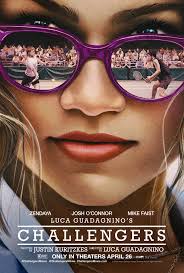
Justin Kuritzkes’ screenplay for Challengers opens at the end — two former friends facing each other across a tennis net, twelve years of history compressed into a single match — and then proceeds to unpick exactly how they arrived there. That structural decision is the screenplay’s central gambit, and it is considerably more elegant than a standard flashback architecture. We are not watching a mystery about what happened. We are watching the match, and the match is the argument — about desire, about competition, about the difference between wanting to win and wanting the person you are playing against. The non-linear structure does not deliver information sequentially; it delivers feeling, and the feeling accumulates differently depending on what you already know. That is a precise and sophisticated use of temporal form, and it is present in every scene.
The screenplay’s most distinctive quality is its refusal to arbitrate between its three protagonists. Tashi, Art and Patrick are locked in a triangle that is never, in the script’s telling, reducible to a simple moral geometry — there is no villain, no victim, no correct reading of who wanted what and who betrayed whom. What Kuritzkes understands is that desire at this intensity does not have a stable perspective from which it can be judged, only a series of moments in which each person is simultaneously pursuing something and being pursued, hurting and being hurt, winning and losing in registers they are not always consciously tracking. For writers seeking screenplay help with ensemble character work or morally open dramatic structures, the script is an object lesson in how to hold three competing centres of consciousness in genuine, unresolved tension without the drama collapsing into relativism. The audience is not let off the hook by being told how to feel. That is a demanding and rewarding structural choice — and one that requires a particular confidence in your own characters to sustain.
The tennis is also doing structural work that rewards close script analysis. Kuritzkes uses the grammar of the sport — the rally, the advantage, the break of serve, the tiebreak — as a structural metaphor so embedded in the screenplay’s architecture that it operates below the level of conscious register. Every scene in the film has a rhythm of this kind: someone serves, someone returns, someone blinks first. The power dynamic shifts from exchange to exchange in precisely the way it shifts in a match, which means the screenplay’s form is enacting its content in every conversation, every glance, every decision about who calls whom and who waits. That integration of metaphor and structure — where the sport is not decoration but dramatic grammar — is one of the things a story structure consultant can help you locate and build into your own work. If your screenplay has a central metaphor, it should be doing this kind of load-bearing work, not merely announcing itself in the dialogue.
If you are developing a feature screenplay with a triangular or ensemble character dynamic — or any project where the structure itself needs to carry the emotional argument — I offer script consultancy, screenplay development support, and detailed story structure feedback tailored to exactly those challenges. I’d love to read what you’re working on.
To find out more read the screenplay here
What do you think the screenplay of Challengers gets right — or wrong? Drop your thoughts in the comments below. And if you’re working on a TV script and want sharp, honest feedback on what’s on the page (and what isn’t yet), take a look at my script consulting services here.