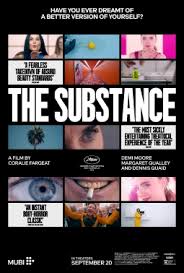
The Substance, written and directed by Coralie Fargeat, is one of the most formally audacious screenplays of recent years — a body horror film that operates simultaneously as visceral spectacle, feminist argument, and satirical demolition of the entertainment industry’s relationship with female ageing. What makes it a significant object of study for writers is not its extremity, which is considerable, but the precision with which that extremity is deployed. Every grotesque image in the film earns its place in the argument. The screenplay never mistakes shock for meaning — it uses shock as the delivery mechanism for meaning, which is an entirely different thing, and one of the hardest tricks in transgressive writing to pull off.
The premise is one of the cleanest and most ruthless in recent memory: a fading television star injects a substance that generates a younger, more perfect version of herself, with the two versions required to alternate existence one week at a time. The rules are simple; the inevitable violations of those rules are the plot; the consequences of those violations are the film’s entire visual and moral argument about self-destruction in the service of an unachievable ideal. That structural elegance — a single, crystalline premise whose internal logic, once set in motion, generates every subsequent scene — is something any writer seeking screenplay help with high-concept material should study carefully. Fargeat does not need subplot or complication. The premise, followed with absolute fidelity to its own logic, is sufficient. The discipline required to trust that sufficiency, and to resist the temptation to soften or diversify the film’s focus, is itself a significant craft achievement.
The screenplay’s relationship to metaphor is worth examining at length. The Substance is, on its surface, a body horror film about a literal scientific procedure. It is also, without ever abandoning that literalness, a film about the way women are trained to experience themselves as simultaneously subject and object — to inhabit their own bodies as performance spaces, perpetually evaluated against a standard that recedes as fast as they approach it. What Fargeat understands, and what the screenplay demonstrates with exceptional clarity, is that the most powerful metaphors in cinema are not decorative but structural: the metaphor is not layered onto the story but built into the premise itself, so that every plot development is simultaneously a narrative event and a thematic argument. For writers seeking story structure help with any film where theme and form need to be fused rather than merely aligned, the screenplay is close to a masterclass. This is precisely the kind of structural decision — where the premise does the thematic work so the scenes don’t have to — that a script consultant can help you identify and build into your own work from the ground up.
The film divided critics in ways that are themselves instructive. Those who found it too schematic — too insistent, too unwilling to complicate its own argument — were identifying a real creative choice rather than a flaw. Fargeat made a decision to pursue her film’s logic to its absolute extreme, forgoing the psychological nuance that a more conventionally structured screenplay might have supplied in favour of an escalating formal and visceral intensity. Whether that trade-off works is a question individual audiences will answer differently. What is not in question is the deliberateness of the decision, and the rigour with which it is executed. For writers working in transgressive or politically engaged cinema, the lesson is clear: know exactly what your film is trading, and trade it consciously. Instinctive or unexamined choices at the level of structure and tone are the ones that create the problems a script editor or screenplay consultant most commonly finds in ambitious drafts that almost work.
If you’re developing a feature screenplay with a high-concept premise that needs to carry serious thematic weight — where the metaphor and the story need to be the same thing — I offer screenplay development support, detailed script analysis, and story structure consultancy for writers working at that level of ambition. I’d love to read your work.
To find out more read the screenplay here
What do you think the screenplay of The Substance gets right — or wrong? Drop your thoughts in the comments below. And if you’re working on a TV script and want sharp, honest feedback on what’s on the page (and what isn’t yet), take a look at my script consulting services here.