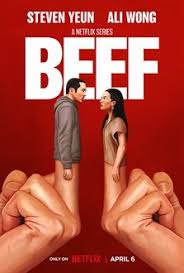
The inciting incident of Beef is a road rage altercation in a Lumber Yard car park that lasts approximately ninety seconds and causes no physical harm to anyone. By the end of the series it has consumed two lives entirely. The pilot’s first and most important job is to make that escalation feel not merely plausible but inevitable — and writer Lee Sung Jin accomplishes this by ensuring that the car park is the last place either character needed to be pushed. Danny Cho and Amy Lau arrive at their confrontation already at the end of something. The road rage doesn’t create the pressure; it releases it. That’s a precise and sophisticated premise construction, and it announces from the first scene that Beef intends to be a show about cause in the deepest sense.
The pilot’s structural efficiency is remarkable. Within its first fifteen minutes it establishes two completely distinct worlds — Danny’s cramped, failing, obligation-heavy life; Amy’s polished, successful, quietly suffocating one — and makes clear that these worlds are mirror images of each other. Both characters are performing a version of themselves that is costing them everything. The screenplay doesn’t state this; it renders it through accumulated, specific, telling detail. For writers wanting help with their script at the level of premise and setup, the pilot is an almost clinical demonstration of how to load a character before the story proper begins — how to make the inciting incident land with the force of an explosion rather than a tap.
There is also something instructive in the pilot’s tonal control. Beef is simultaneously funny and genuinely distressing, sometimes within the same scene, occasionally within the same shot. That tonal range is not accidental — it’s the show’s argument, that the comic and the tragic are not opposites but the same material viewed from different distances. Managing that register without lurching or losing the audience’s trust is one of the hardest things a screenplay can attempt. Writers developing dark comedy or tragicomedy will find the pilot invaluable on precisely this point: the tone is held not by mood but by the rigour of the character logic underneath it.
If you’re developing a high-concept premise and want to stress-test whether it’s carrying the weight you’re asking of it — or if your script’s tonal balance isn’t quite landing — my script consultancy offers the kind of focused, detailed script notes that get to the root of what a draft needs. Whether it’s premise, structure, character, or tone, I’d love to take a look.
To find out more download the pilot script here