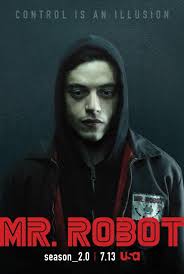
The Mr. Robot pilot opens with Elliot Alderson talking directly to us. Not to another character, not to a room — to us, specifically, with the slightly unnerving intimacy of someone who has decided, for reasons of their own, to let us in. It is a choice that immediately raises the question every unreliable narrator raises: in on what, exactly? And to what end? Sam Esmail plants that uncertainty in the pilot’s very first scene and never fully resolves it. That productive instability — the audience perpetually calibrating how much to trust what they’re being shown — is the engine the entire series runs on, and it is engineered with exceptional precision from the first page.
What makes the pilot’s use of voiceover so sophisticated is that it functions simultaneously as intimacy and misdirection. Elliot tells us things — about his worldview, his targets, his contempt for the machinery of corporate power — that feel confessional and unguarded. The screenplay lets us believe we are being trusted with the truth. That belief is the trap. For writers seeking scriptwriting help with first-person or voiceover-driven narratives, the pilot is an object lesson in the difference between a narrator who withholds and one who deceives: Elliot does not refuse to tell us things — he tells us everything, selectively framed. The unreliability is structural, not evasive, which makes it far more destabilising.
The pilot’s story structure is also worth close attention. Esmail works in the thriller tradition — escalating pressure, ticking clock, a climax that forecloses one set of possibilities and opens another — but the genre scaffolding is constantly undermined by Elliot’s interiority. Every external event is filtered through a consciousness we are simultaneously inhabiting and doubting. That double movement, between plot and perception, is what lifts the show above its genre premises. It is, at its core, a screenplay about epistemology: about what we can know, and who gets to decide. Anyone wanting help with their screenplay who is working in psychological thriller territory will find the pilot an invaluable reference for how form and content can be made to interrogate each other.
If your script is doing something formally ambitious — an unreliable narrator, a subjective reality, a story where the audience’s trust is itself a dramatic variable — that’s precisely the kind of work that benefits from a screenplay consultant who can evaluate whether the effect you’re building is landing as intended. We offer detailed script analysis and story structure consultancy for writers working at the edges of conventional form.
To find out more download the pilot script here