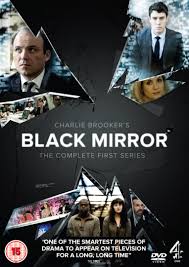
Charlie Brooker’s Black Mirror arrives with a premise so baldly confrontational that summarising it is itself a provocation: the British Prime Minister is blackmailed into a sex act with a pig, broadcast live on national television, as the price of a kidnapped princess’s release. On paper it sounds like a stunt. On screen — and this is the measure of the writing — it is one of the most genuinely uncomfortable hours of television of the last fifteen years. The distance between those two facts is where the craft lives, and it repays close attention from any writer working in high-concept or speculative drama.
The first and most important thing the pilot does is refuse to wink. The National Anthem — written by Brooker with characteristic economy and precision — treats its grotesque premise with total seriousness, and that commitment is what transforms it from provocation into drama. The story is not about the act; it is about the machinery of modern media, political image management, and the public’s relationship with spectacle. The premise is the delivery mechanism for those ideas, not the point in itself. For writers seeking screenplay help with high-concept material, that distinction is everything: the concept must be in service of something, or it remains merely a concept.
The story structure is a pressure cooker — linear, relentless, almost classical in its unities of time and place. As the deadline approaches, the screenplay strips away every possible escape route, one by one, with methodical cruelty. Each scene closes a door. That narrowing is not just dramatic mechanics; it is an argument about complicity. By the time the Prime Minister capitulates, the audience has been made to feel its own culpability in having watched — which is, of course, precisely what Brooker intended. The script analysis question worth asking here is: how does a screenplay make its audience implicated in what they’re watching? The National Anthem answers it more ruthlessly than almost anything else on television.
There is also something instructive in the episode’s restraint. The most extreme content happens either off-screen or at a distance. The horror is ambient, not graphic — built from implication, from reaction shots, from the faces of people watching something we are spared. That is sophisticated screenwriting: understanding that imagination, properly activated, is more powerful than explicitness. Writers looking for help with their screenplay who are working in dark or transgressive territory would do well to study exactly where Brooker places his cuts.
If you’re developing a high-concept or speculative drama — a script where a bold idea needs to be transformed into genuine human stakes — our script consultancy offers the kind of forensic screenplay analysis and story structure help that can make the difference between a premise that intrigues and a script that lands. I’d love to read your work.
To find out more download the pilot script here