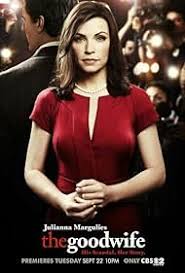
The Good Wife pilot opens on a press conference — a politician’s public confession, a wife standing beside him, her face arranged into an expression of composed, terrible neutrality. It is an image the audience already knows from a dozen real-world scandals, and Robert and Michelle King use that familiarity deliberately. We think, for a moment, that we know what kind of show this is. The pilot’s first and most elegant move is to take that assumption and quietly dismantle it, scene by scene, until Alicia Florrick has become something the press conference image specifically denied her: a protagonist with full interiority, full agency, and a story entirely her own.
That reframing is the pilot’s central structural achievement. Alicia begins the episode defined entirely by her husband’s disgrace — she is, as the title announces, the good wife, a supporting character in someone else’s scandal. The screenplay’s task is to transform her, within forty-five minutes, into a woman capable of carrying a seven-season drama. It does so not through revelation or catharsis but through the procedural engine of her first day back at work. Every courtroom scene, every small professional humiliation navigated and absorbed, every moment of competence quietly asserted — these are the incremental steps by which the pilot transfers dramatic authority from Peter Florrick’s scandal to Alicia’s interior life. For writers seeking help with their screenplay who are building a protagonist from a position of constraint, this is an object lesson in how to do it without shortcuts.
The procedural structure deserves attention too. The Kings understood that network drama runs on the case-of-the-week engine, and the pilot uses that convention intelligently — the legal case gives Alicia something to do, a concrete arena in which her competence can be established and tested. But it never mistakes the case for the story. The case is the vehicle; the story is a woman deciding, in real time and largely in private, who she intends to be from here. That layering — procedural surface, character drama underneath — is one of the most reliable structural models in television writing, and the Good Wife pilot executes it with uncommon authority. Writers looking for story structure help with procedural drama will find the pilot invaluable on exactly this point: the formula is not the enemy of character depth, provided the writer knows which one is serving which.
If you’re developing a drama where your protagonist needs to be established against the grain of their circumstances — or where a procedural format needs to carry genuine character weight — that’s precisely the territory where experienced script analysis and story development support can make the difference. My script consultancy works with television and film writers at every stage.
To find out more download the pilot script here