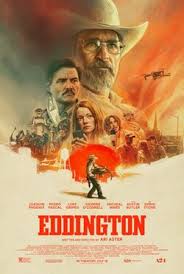
Ari Aster described Eddington as a Western in which the guns are phones — a line that does considerable work as both a pitch and a thesis statement. The film is set during the tumultuous summer of May 2020, and functions as a microcosm for a nation sifting reality through social media. Sheriff Joe Cross runs against the incumbent mayor of a small New Mexico town; neighbour turns against neighbour; the information ecosystem does what information ecosystems now do. As a piece of high-concept screenplay writing, the premise is as clean and legible as any western: two men, one town, a contest for power. What Aster is doing underneath that legibility is considerably more complicated, and the screenplay’s ambitions — and the critical debate they generated — make it one of the most instructive recent examples of the risks and rewards of satire as dramatic form.
The screenplay’s most distinctive structural decision is its refusal of a moral centre. Aster aimed for a democratic approach in which every character has a point, even if expressed in warped or deluded ways. Joe Cross is neither hero nor villain; Ted Garcia is neither saviour nor straightforward antagonist; Louise’s drift into conspiracy thinking is rendered with empathy rather than contempt. That evenhandedness is both the screenplay’s greatest strength and the source of its most pointed critical controversy. Several reviewers found the moral agnosticism liberating; others found it evasive. That divide is itself instructive for any writer working on political satire or dark comedy: the decision to withhold authorial judgment is not a neutral act. It is a tonal and structural commitment with real consequences for how the audience experiences the work, and it needs to be made with full awareness of what it costs as well as what it enables. This is precisely the kind of craft decision — where form and ethics are inseparable — that repays close screenplay analysis and benefits from experienced outside eyes during development.
The western genre frame is doing important structural work throughout. While the film utilises the visual language of the American Southwest, Aster’s script is a dissection of the modern information ecosystem — the landscape, in other words, is not merely setting but argument. The mythic grammar of the western (the lone lawman, the corrupt power structure, the town that must choose sides) is imported precisely because it carries an audience’s expectations about moral clarity, and then systematically undermined by a world in which moral clarity has been made structurally unavailable. That use of genre as a set of expectations to be activated and disappointed is a sophisticated screenwriting technique, and the screenplay deploys it with considerable intelligence. For writers seeking help with their screenplay who are working in genre-blending or satirical territory, Eddington is a useful and challenging case study: a film that demonstrates both the power of the approach and, in the view of some of its critics, the dangers of pushing it past the point where an audience can locate its emotional bearings.
If you’re developing a feature screenplay with satirical ambitions — a high-concept premise that needs to carry both genre pleasures and serious thematic weight — I offer screenplay analysis, script development support, and detailed script notes tailored to exactly those challenges. I’d love to read what you’re working on.
To find out more read the screenplay here