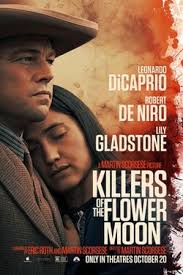
The most discussed decision in Eric Roth and Martin Scorsese’s screenplay for Killers of the Flower Moon is also its most morally serious: the choice to tell the story of the Osage murders not from the perspective of the FBI investigators who eventually brought some of the perpetrators to justice, but from inside the perpetrating family itself. Ernest Burkhart — weak, greedy, in genuine thrall to his uncle William Hale, and genuinely in love with his Osage wife Mollie — is the film’s centre of consciousness. That choice is a perspective decision and a structural one, and it is also, inescapably, a moral argument: by placing the audience inside the consciousness of a man who participates in the systematic murder of his wife’s people, the screenplay refuses the comfort of witnessing at a safe distance. We are not watching the crime from outside. We are watching it from a position of complicity, which is exactly where Scorsese and Roth want us.
The structural consequences of that decision are considerable, and worth examining closely. A screenplay built around the FBI investigation — the version that was reportedly considered and rejected — would have been, in narrative terms, a procedural: a story about the gathering of evidence, the construction of a case, the eventual triumph of the law. That is a familiar and satisfying structure, but it would have placed the Osage Nation primarily in the position of victims awaiting rescue, which is a framing the film explicitly declines. By centering Ernest, the screenplay keeps Mollie and the Osage world in the foreground as living, complex, present people — not as the objects of a crime that happened to them, but as the protagonists of their own story who are being destroyed by people close to them. That reframing — achieved through a single, consequential perspective decision — is one of the most instructive examples in recent cinema of how structural choices carry ethical weight. For writers seeking story structure help with any true story drama or historical screenplay, the lesson is precise: whose consciousness you enter determines whose story you are telling, and that is a moral decision as much as a narrative one.
The screenplay’s handling of Ernest’s interiority is also worth close script analysis. Roth and Scorsese resist the temptation to make Ernest’s psychology legible in any final sense — he is not a monster, not a dupe, not a man who doesn’t know what he is doing. He is something more disturbing: a man who holds love and murder in simultaneous suspension, who is capable of both without either cancelling the other. That psychological complexity is built into the screenplay from Ernest’s first scene, and it is sustained without resolution for three and a half hours. The discomfort that creates — the audience’s inability to locate a stable moral position from which to judge him — is not a failure of the screenplay but its central achievement. Managing that kind of sustained moral ambiguity across a film of this scale requires exceptional structural discipline, and is precisely the kind of challenge where detailed screenplay feedback and story development support can help a writer understand whether their own handling of a morally complex protagonist is landing as intended.
The film’s final sequence — in which Scorsese himself appears as a radio announcer collapsing the Osage story into a brief historical footnote, before the Osage perform their own mourning ceremony in direct address — is a structural decision of great boldness. It breaks the film’s fourth wall to ask who gets to tell this story and how much of it is retained. That question is built into the screenplay’s architecture from the first scene, and the ending is its most explicit statement. For writers working on any project where the ethics of storytelling are themselves part of the story — where form and subject are inseparable — this screenplay is among the most rigorous examples the contemporary cinema has produced.
If you are developing a historical drama, a true story adaptation, or any screenplay where perspective is doing moral and structural work simultaneously, I offer screenplay development support, detailed script analysis, and story structure consultancy for writers working at that level of ambition. I’d love to read your work.
To find out more read the screenplay here
What do you think the screenplay of Killers of the Flower Moon gets right — or wrong? Drop your thoughts in the comments below. And if you’re working on a TV script and want sharp, honest feedback on what’s on the page (and what isn’t yet), take a look at my script consulting services here.