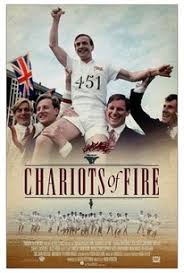
Colin Welland’s Oscar-winning screenplay for Chariots of Fire solves one of the oldest problems in dramatic writing with elegant simplicity: how do you generate tension in a story whose outcome the audience already knows? Harold Abrahams and Eric Liddell both ran at the 1924 Paris Olympics; both won gold medals; both are historical fact. The screenplay’s answer is to make the race the least interesting thing about the film. What matters — what generates the drama across two hours of impeccably structured writing — is not whether these men will win, but what they are running for, and whether what they are running for is worth the cost. That reframing, from athletic outcome to interior motivation, is the screenplay’s founding creative decision, and it is made before the opening titles have finished.
The dual protagonist structure is the screenplay’s central architectural achievement. Abrahams and Liddell are not simply two men who happen to both be runners; they are a precisely calibrated thematic contrast. Abrahams runs to overcome — to prove, against the patrician anti-Semitism of the Cambridge establishment, that he belongs in rooms that would prefer him elsewhere. Liddell runs to express — to honour, in the speed and joy of physical movement, a God he experiences as present in his running. One man’s motivation is external and social; the other’s is internal and transcendent. Those two motivations are set in deliberate, illuminating opposition throughout the screenplay, so that every scene involving one protagonist implicitly comments on the other. For writers seeking story structure help with dual protagonist drama, the screenplay is a near-perfect model of how to ensure that two central characters are doing thematic work rather than merely sharing screen time — each one needs to be the argument the other is tested against.
The screenplay’s handling of the British class system — the Cambridge high tables, the Amateur Athletic Association’s paternalism, the establishment’s instinctive hostility to anyone who runs too hard or too openly or for reasons they consider ungentlemanly — is also worth studying as dramatic writing. Welland doesn’t render this world as simple villainy; he renders it as atmosphere, as assumption, as the invisible water these characters swim in. The obstacles Abrahams faces are not melodramatic confrontations but the accumulated weight of an entire social order whose preferences are so naturalised as to appear merely reasonable. That texture — opposition as atmosphere rather than antagonist — is considerably harder to achieve on the page than a conventional dramatic conflict, and considerably more truthful to how systemic prejudice actually operates. Close script analysis of the Cambridge sequences reveals a screenplay doing this with exceptional precision and economy, in ways that repay careful study for any writer developing a period drama or any story where the social world is itself the obstacle.
The screenplay also demonstrates a quality of restraint that has become rarer in contemporary feature writing. It trusts its audience to make connections without having them underlined. It allows scenes to end before they have exhausted their implications. It is confident that character, established with sufficient precision, will generate emotion without being engineered towards it. Those qualities — economy, trust, restraint — are among the hardest things to develop as a writer and among the things I find most useful to discuss when offering screenplay feedback and script development support to writers at any stage of their careers.
If you are developing a period drama, a true story adaptation, or any screenplay built around two protagonists whose stories illuminate each other, I offer script consultancy, detailed screenplay analysis, and story structure support tailored to exactly those demands. I’d love to read your work.
To find out more read the screenplay here
What do you think the screenplay of Chariots of Fire gets right — or wrong? Drop your thoughts in the comments below. And if you’re working on a TV script and want sharp, honest feedback on what’s on the page (and what isn’t yet), take a look at my script consulting services here.