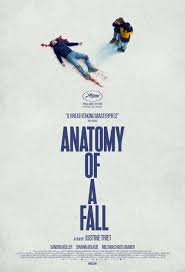
Justine Triet and Arthur Harari’s screenplay for Anatomy of a Fall is built around a question it has no intention of answering: did Sandra Voyter kill her husband, or did he fall? The film runs for two and a half hours in the formal register of a courtroom drama, a genre whose entire grammar is organised around the delivery of a verdict, and then declines to deliver one. That refusal is not evasion but argument. The screenplay’s position is that the question of guilt — in this marriage, in this death, in this courtroom — cannot be separated from the question of narrative itself: who gets to tell the story, whose version is treated as credible, and what the law’s demand for a single definitive account does to the irreducible complexity of a life lived between two people in private. For writers thinking seriously about how screenplay structure can carry a philosophical argument, Anatomy of a Fall is among the most rigorous and demanding examples of the form produced in recent years.
The screenplay’s structural intelligence lies in its use of the courtroom as a machine for producing competing narratives. Every witness, every piece of evidence, every exchange between counsel is designed not to advance the audience toward a conclusion but to demonstrate how thoroughly the same facts can be made to support contradictory interpretations. The recorded argument between Sandra and Samuel — the tape that forms the centrepiece of the trial — is the screenplay’s most brilliant single set-piece: a scene that is simultaneously the most intimate and the most contested thing in the film, the closest we get to the truth of this marriage and the moment at which truth becomes most definitively inaccessible. Triet and Harari build the entire trial around that tape, which means they have structured the film around an absence — the thing that would resolve the question is the thing that most completely refuses resolution. For writers seeking screenplay help with mystery or legal drama, or any story where productive ambiguity is the central dramatic instrument, this structural decision is worth studying in forensic detail.
The screenplay’s handling of Daniel — the couple’s partially sighted son, who becomes the trial’s most important witness — is also exceptional and worth close script analysis. Daniel is not simply a plot device or an emotional amplifier; he is the film’s moral centre, the person for whom the question of his mother’s guilt or innocence is not an intellectual exercise but the organising fact of the rest of his life. His testimony — the moment at which a child must decide what he believes about his own parent, in public, under oath — is the film’s emotional and structural climax, and it is prepared for with extraordinary care across the preceding two hours. The screenplay trusts that an audience will wait for that scene if the waiting has been made worthwhile, which is a form of structural confidence that requires absolute faith in your own material. This is the kind of long-game structural planning — understanding precisely where your film’s true climax lives, and building everything in service of it — that detailed story structure consultancy can help a writer identify and execute at every stage of development.
The film also raises, obliquely but persistently, questions about language, translation, and the reliability of self-expression that connect its personal drama to something larger. Sandra speaks in her second language throughout the trial; the gap between what she means and what can be received — between private truth and public legibility — is built into the film’s texture from its first scene. That integration of theme and dramatic situation, where the personal story and the larger argument are made from the same material, is a mark of writing at the highest level of craft. It is also, in my experience offering screenplay feedback and script analysis to writers across a wide range of projects, one of the qualities that most reliably distinguishes a screenplay that is doing something genuinely original from one that is merely executing its genre competently.
If you are developing a legal drama, a mystery, or any screenplay where ambiguity is the structural engine rather than a problem to be solved, I offer screenplay development support, detailed script analysis, and story structure consultancy for writers working at that level of ambition. I’d love to read what you’re making.
To find out more read the screenplay here
What do you think the screenplay of Anatomy of a Fall gets right — or wrong? Drop your thoughts in the comments below. And if you’re working on a TV script and want sharp, honest feedback on what’s on the page (and what isn’t yet), take a look at my script consulting services here.