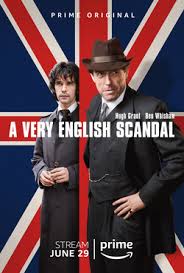
The opening scene of A Very English Scandal is a man in a Rolls-Royce propositioning a young man at a bus stop in the rain, conducting the entire transaction with the brisk, unselfconscious efficiency of someone ordering lunch. It establishes, in under a minute, everything the series needs the audience to understand about Jeremy Thorpe: his appetite, his recklessness, his absolute confidence that the world will accommodate him, and the precise social register — establishment, entitled, unimpeachably English — in which all of it will be conducted. Russell T Davies’ screenplay announces its tonal hand immediately, and that tone — a kind of horrified, delighted, perfectly pitched dark comedy of manners — is one of the most precisely calibrated in recent British television. For writers working on true story adaptation, the pilot is a lesson in how tone is not merely a register but a moral argument.
The craft challenge of adapting this particular true story — the Jeremy Thorpe affair, in which a Liberal Party leader conspired to have his former lover murdered — is one of proportion and perspective. The events are, objectively, both appalling and farcical, and Davies understands that treating them as exclusively one or the other would be a falsification. The pilot holds both simultaneously, which is a tonal achievement of real sophistication. Thorpe’s charm is rendered as genuine, his monstrousness as incremental, and the English establishment’s complicity as something so deeply systemic as to be almost invisible to those inside it. That moral complexity is not editorialised; it is structural. The screenplay builds its argument into the architecture of each scene rather than the attitude of its narration. Writers seeking screenplay help with true story or biographical drama — where the ethical obligations are complex and the tonal decisions carry real weight — will find the pilot an invaluable model for how to let form carry judgment without ever becoming polemic.
The dual protagonist structure — Thorpe and Norman Scott occupying roughly equal dramatic space from the pilot’s earliest scenes — is also worth studying closely. Davies understands that the story’s moral centre is Scott: the younger, less powerful, more vulnerable man whose life Thorpe will attempt to end. But by granting both men full interiority from the beginning, the pilot ensures that Thorpe never becomes a cartoon villain and Scott never becomes merely a victim. Both are rendered as complete human beings in an impossible situation of radically unequal power. That balance — granting full humanity to both the powerful and the powerless in the same story — is one of the hardest things a screenplay can attempt, and one of the things I look at most carefully when offering script analysis and screenplay development support to writers working in this territory.
If you’re developing a true story drama, a limited series, or any project where tone is doing the moral heavy lifting — where how you tell the story is inseparable from what the story argues — I offer script consultancy, detailed screenplay feedback, and story structure support tailored to exactly those demands. I’d love to read your work.
To find out more read the pilot script here