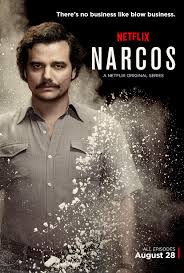
The Narcos pilot opens with a provocation: “Magical realism is just another way of saying ‘the shit that happens in this country.'” It’s a line that does the work of three scenes — it establishes voice, sets geography, and signals that this show will not be interested in flattering anyone’s expectations. As an opening gambit, it’s close to perfect. And as a lesson in story structure, it’s worth pulling apart stitch by stitch.
What creator Chris Brancato and his team understood is that Narcos had an unusual structural problem. The story of Pablo Escobar is not a mystery — everyone knows how it ends. The pilot’s job, then, is not to generate suspense about outcome but about process: how does a man become a monster, and how does an institution attempt to stop him? The solution is the voiceover. DEA agent Steve Murphy narrates from a point beyond the events we’re watching, which paradoxically intensifies tension rather than diffusing it. We’re not wondering what happens — we’re watching a man trying to make sense of something that has already happened to him. That’s a sophisticated story structure choice, and one that few pilots execute with this kind of confidence.
The screenplay also makes an early commitment that rewards close script analysis: it refuses to choose between its two protagonists. Murphy and Escobar receive almost equal screen time in the pilot, and neither is framed as straightforwardly heroic. Escobar’s early scenes are oddly domestic — a man building a business, navigating family, solving logistical problems. The horror accrues slowly. This structural balance — intercutting two origin stories that the audience knows must eventually collide — creates a dramatic irony that carries the entire first season. If you’re looking for screenplay help with a story that has multiple centres of gravity, this pilot is an object lesson in how to hold them in equilibrium without losing narrative momentum.
There’s also something instructive in what the pilot withholds. It doesn’t attempt to explain Colombia, the cocaine trade, or the political landscape in any depth. It trusts that jeopardy and character will carry the audience long enough for context to arrive naturally. For anyone seeking scriptwriting help with an exposition-heavy subject, that restraint is worth studying: the world builds through action, not briefing.
If your script is wrestling with similar challenges — a true story, a dual protagonist structure, a world that risks overwhelming the human drama at its centre — a script consultant can help you find the spine beneath the research. Whether you need story structure advice, script analysis, or help shaping a pilot from the ground up, that’s exactly what I’m here for.
To find out more download the pilot script here