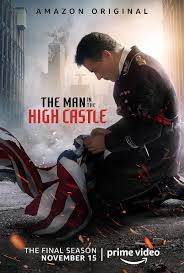
The central problem of any counter-factual drama is one of orientation: how do you build a world that diverges from the one the audience knows, without either over-explaining it or leaving them too disoriented to invest? Frank Spotnitz’s adaptation of Philip K. Dick’s novel solves this problem with considerable craft. The pilot of The Man in the High Castle builds its alternative 1962 America — a continent divided between Japanese and Nazi occupation — not through exposition but through accumulation: the flags, the uniforms, the casual brutality normalised into civic routine. The world is established in the texture of ordinary life before any character explains it, which is the only method that produces genuine immersion rather than the appearance of it.
The structural decision to follow multiple protagonists across the divided continent is both the pilot’s greatest strength and its most demanding craft challenge. Juliana Crain in the Japanese Pacific States, Joe Blake in the Greater Nazi Reich, and Frank Frink in San Francisco each inhabit a different facet of the occupation’s logic — different relationships to collaboration, resistance, and survival. The pilot establishes these perspectives with economy and without confusion, which is harder than it looks across a world this elaborately constructed. For writers seeking screenplay help with large-canvas speculative drama — stories where the world itself is as complex as any character — the pilot’s method of anchoring each strand in an immediately legible personal stakes is the key lesson. The world-building earns the audience’s attention; the human story keeps it.
What makes the pilot most instructive from a story structure standpoint is the film-within-the-film — the newsreel footage of an alternative history in which the Allies won, which the characters risk everything to possess and distribute. That object does extraordinary structural work. It introduces the show’s central metaphysical question — what is the relationship between a world and the stories told about it? — without ever stating it plainly. It gives each protagonist a concrete dramatic objective. And it plants, in the pilot’s final minutes, a mystery large enough to sustain a series: if this film exists, who made it, and why? The best speculative screenwriting understands that the genre’s ideas must always be embodied in objects, choices, and consequences rather than argument — and the newsreel is a near-perfect example of that principle in practice. Writers looking for script analysis help with speculative or high-concept material will find that discipline — idea as object, theme as dramatic fact — worth internalising deeply.
If you’re developing an alternative history drama, a speculative adaptation, or any large-canvas project where world-building and human story need to be constructed in precise balance, I offer script consultancy, screenplay development support, and detailed script analysis for writers working at the more ambitious end of the form. I’d love to read what you’re making.
To find out more read the pilot script here