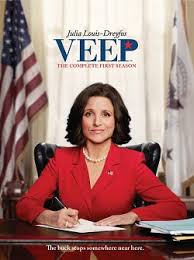
The Veep pilot has the density of a great short story. In twenty-eight minutes, Armando Iannucci and co-writer Simon Blackwell establish a protagonist, an ensemble of seven distinct supporting characters, a workplace world with its own precise internal logic, a comic register of blistering specificity, and a central dramatic irony that will power the entire series: the second most powerful person in America has no actual power whatsoever. That economy is not accidental. It is the product of writers who understand that comedy, more than any other form, cannot afford a wasted line — and whose room, one imagines, was extremely disciplined about cutting anything that didn’t earn its place three times over.
The pilot’s approach to ensemble is worth studying closely. Each member of Selina Meyer’s staff is defined not just by personality but by a specific, distinct relationship to failure. Gary absorbs it; Dan deflects it; Amy manages it; Mike ignores it; Jonah embodies it. That differentiation is established within the pilot’s first ten minutes, and it is what makes the ensemble’s collective dysfunction legible as comedy rather than noise. For writers seeking comedy writing help or scriptwriting help with ensemble casts, the pilot is a clinic in how to make a large group of characters simultaneously comprehensible and chaotic — the audience must be able to track who everyone is and what they want at the exact moment everything is falling apart around them.
The dialogue deserves its own study. Iannucci and Blackwell write in a register that is simultaneously hyper-articulate and completely unguarded — characters say, at high velocity, things that most people would spend considerable effort not saying. The insults are baroque, the euphemisms are magnificent, and the gap between the official language of political life and the language actually being used in every corridor and anteroom is the show’s permanent comic engine. That gap — between performed dignity and actual behaviour — is Veep‘s equivalent of the structural irony that drives WWDITS or GLOW: a premise built from the collision of self-image and reality. Identifying that collision and designing your world around it is, as the best pilots in this series demonstrate, one of the most reliable foundations a comedy can have. A script editor or screenplay consultant with experience in comedy can help you locate exactly where that collision lives in your own work — and whether the writing is exploiting it to its full potential.
If you’re developing a comedy pilot — ensemble, single protagonist, political, workplace, or otherwise — and want rigorous, experienced script analysis and comedy writing feedback, I’d love to read it. Get in touch to find out more.
To find out more read the pilot script here